

Header Image: Jasper Van Hoorick from BIO INX with the HealthTech Investor Summit’s People’s Choice Award 2025 (© Kris Van de Sande)
Picture a 3D printer in action: its arm moving back and forth, building up the layers of a new creation. Except instead of a plastic figurine, this printer is working on something far more intricate: printing human heart cells onto a miniature chip. This is the magic made possible by bioprinting — where living cells or proteins are mixed with materials called ‘bioinks’ to create functional organic tissues.
“Bioprinting is a relatively new field,” says Jasper Van Hoorick, CEO and Co-Founder of BIO INX. “The method was first described in a paper about twenty years ago, but it’s only recently that bioprinting has started to gain traction outside of academic labs.”
Printing Living Matter
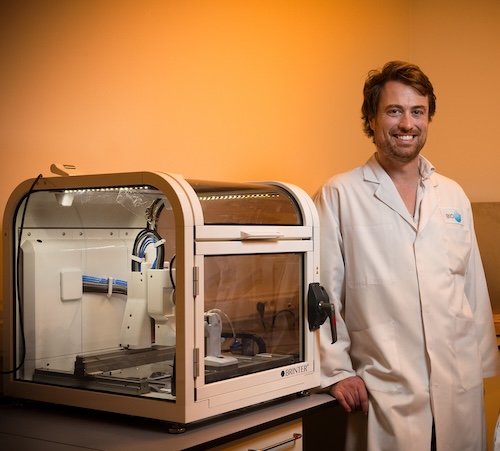
BIO INX is a new startup, spun out of the biomaterials research group at Ghent University and Vrije Universiteit Brussel in 2022. It was co-founded among others by Van Hoorick and Aysu Arslan, now CSO of the company.
“There was a lot of bioprinting research being done but it wasn’t being translated into real-world applications.” – Jasper Van Hoorick
“The motivation for BIO INX began when Aysu and I were doing our PhDs, because we saw that there was a lot of bioprinting research being done but it wasn’t being translated into real-world applications,” says Van Hoorick.
The two founders decided their best approach for advancing the field was to standardize and commercialize the bioinks themselves — materials like hydrogels, which protect the cells during the printing process, then support cell survival and tissue formation afterwards.
From Light to Life
BIO INX works together with partners and customers to develop purpose-made bioinks for four different types of bioprinting: volumetric printing, deposition-based printing, digital light processing, and multiphoton lithography. “The light-based bioprinting technologies are where we shine, because this is still a really new technology with very few commercially available bioinks.”
Light-based bioprinting is comparable to classic 3D resin printing, where a UV light source is used to harden a liquid photopolymer into a solid object. What sets it apart from other types of bioprinting is the extremely high resolution.
“We strongly believe that light-based techniques are the future of bioprinting.” – Jasper Van Hoorick
“These are the only technologies where you can actually print down to sub-cellular dimensions,” says Van Hoorick. “That means you can create the complicated, microscopic architectures of natural tissues, which is why we strongly believe that light-based techniques are the future of bioprinting.”
Restoring Sight to the Blind
Because of the range of bioprinting techniques available to BIO INX, the potential applications are numerous and diverse. To start with, the company is working with partners to create simple organic tissues, without blood vessels or an inherent regenerative capacity.
“Bioprinting has an enormous potential to restore sight to many people in need.” – Jasper Van Hoorick

“One of our most exciting projects is an ocular application, where we’re working together with a client to bioprint corneas,” says Van Hoorick. If a cornea is damaged, then the only way to restore vision is via a transplant. But currently, there’s only one donor for every seventy patients who need a corneal transplant.
“Since the eye is immune privileged and the cornea doesn’t require blood vessels, this is an application where bioprinting has an enormous potential to restore sight to many people in need,” says Van Hoorick.
BIO INX is also working on bioprinted bone and cartilage, together with other partners. Architecturally, bone and cartilage aren’t complex: there’s no blood vessel penetration, so it becomes more feasible to bioprint functional tissue.
“One day we believe we’ll also have complex 3D-printed tissues which can auto-regenerate,” says Van Hoorick. “But the cornea, bone and cartilage projects will likely be the first BIO INX projects to make it out of the lab and into the clinic.”
From Earth to Space
Beyond tissue transplants, BIO INX has several ambitious projects underway involving organ-on-chip platforms. These are small devices that mimic the complex physiology, mechanics, and 3D structure of organs, by lining tiny channels on a chip with living cells and using microfluidics to simulate the flow of blood and nutrients.
“Organ-on-chip technology has tremendous potential in the animal-free testing space, where these devices can replace unnecessary animal experiments and enable pre-clinical work with human tissues,” says Van Hoorick.
“Lasers, broken hearts, and space stations — it sounds like science fiction, but it’s real!” – Jasper Van Hoorick
BIO INX is also part of AstroCardia — an ambitious project to launch a bioprinted heart-on-chip into space. Biovia’s precursor MEDVIA helped assemble the project consortium and supported the successful application for €1.75 million in VLAIO funding, turning the project dream into reality.
Together with the four other Belgian consortium partners – SCK CEN, Space Applications Services, QbD Group, and Antleron – BIO INX developed the heart-on-chip, which is due to be sent to the International Space Station in 2026. “Lasers, broken hearts, and space stations — it sounds like science fiction, but it’s real!” says Van Hoorick.
Read this article to find out more about AstroCardia!
Out of the Lab and Into the Clinic
In December 2025, BIO INX attended the HealthTech Investor Summit, where the start-up took home the People’s Choice Award for best pitch. “The Summit was great for us, because we’re actively fundraising. We were able to meet a lot of potential investors there — funds we’d already identified as interesting, but also others who discovered us at the event and have since reached out,” says Van Hoorick.
“We want to help move the bioprinting field closer to real-world applications with tangible patient impact.” – Jasper Van Hoorick
BIO INX is raising capital to accelerate the commercialization of its bioinks. “In the last three years, we’ve focused on getting the technology out there — building our materials portfolio, establishing an academic customer base, and working on our use cases,” he says. “The next step is to bring that technology to non-academic customers.”
“By now, there are thousands of academic papers that say bioprinting has potential, but so far these ideas have rarely made it out of the lab and into the clinic. This is why we launched BIO INX — because we want to help move the bioprinting field closer to real-world applications with tangible patient impact.”