

An estimated 1 in 3 Belgians live with a fatty liver. Often linked to sedentary lifestyles, unhealthy diets, and environmental stressors, fatty liver disease is a silent but serious condition. As fat accumulates in the liver, oxidation and inflammation can lead to fibrosis. This permanent damage increases the risk of cardiovascular disease, diabetes, kidney failure, and liver cancer.
The good news is that, in its early stages, the disease is reversible. This is what project Alga-Care aims to investigate, with a unique interdisciplinary approach.
A Growing Medical Concern
The new VLAIO-funded project Alga-Care is exploring whether microalgae could help prevent fatty liver disease. The project consortium consists of Flanders Research Institute for Agriculture, Fisheries and Food (ILVO), University Antwerp, and Free University Brussels (VUB), and involves a three-year search for bioactive compounds that could counteract liver oxidation or improve the composition of fat in the liver.
“Fatty liver disease is becoming almost epidemic in Western societies.” – Johan Robbens
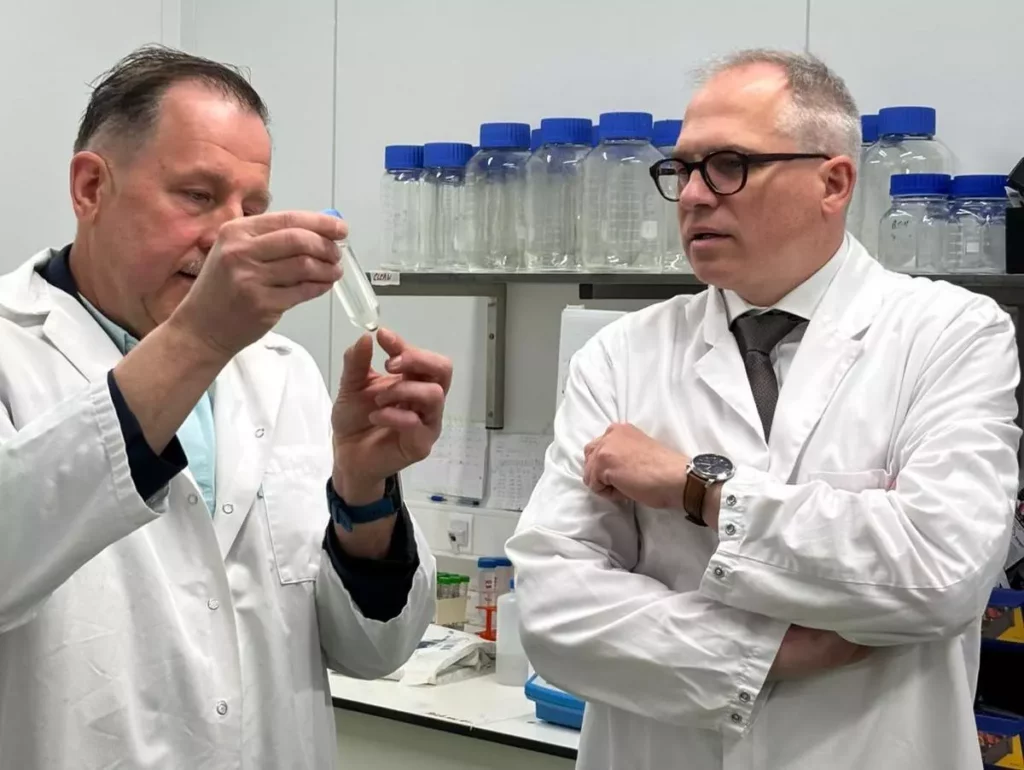
“Fatty liver disease is becoming almost epidemic in Western societies,” says Dr. Johan Robbens, Alga-Care coordinator and head of the Blue Biotechnology and Food Integrity Unit at ILVO. “We want to focus on the initial stages, when the disease is still reversible. The idea is to avoid that it progresses too far, and to intervene earlier with a nutraceutical or preventive product.”
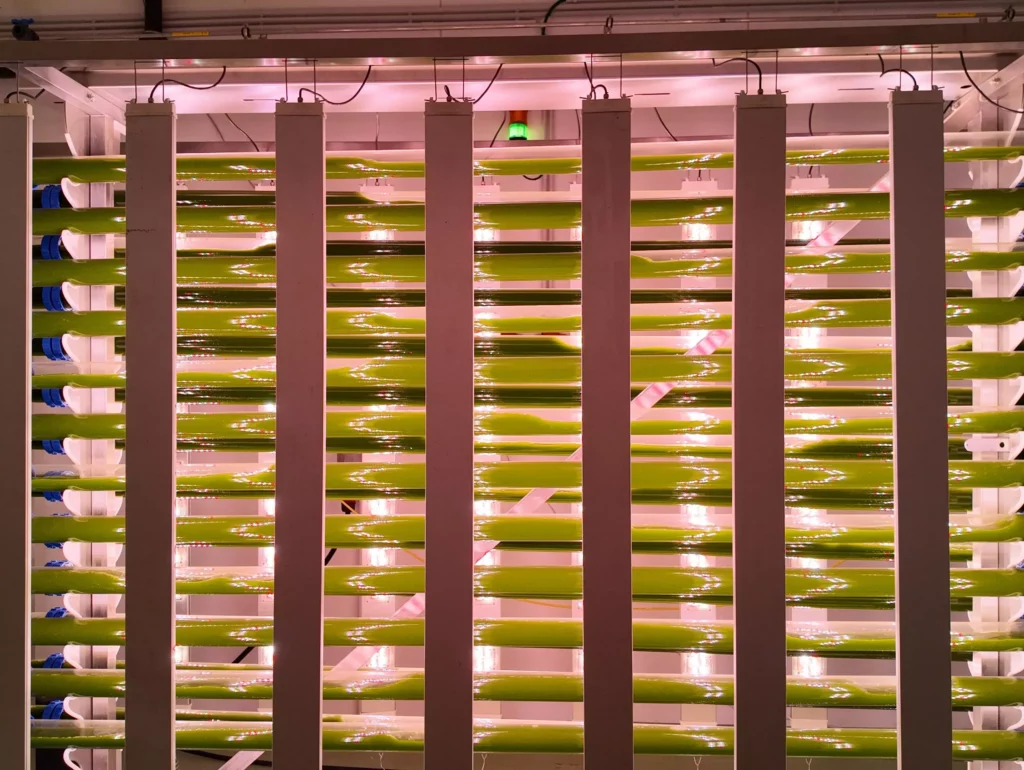
Alga-Care was officially inaugurated on April 17 at ILVO in Ostend, where Flemish Minister-President Matthias Diependaele turned on a new 300-liter microalgal photobioreactor. This installation will allow researchers to cultivate microalgae under controlled conditions and study how variables such as light intensity, nutrients, temperature, and oxidative stress influence the compounds they produce.
In total, the project aims to screen hundreds of microalgal extracts, and evaluate the most promising compounds in liver organoids and mice with fatty liver.
From Marine Biology to Human Health
Microalgae are single-celled organisms that can be grown at scale using light and basic nutrients. Some can also be cultivated in the dark with a carbon source, allowing researchers to compare how different growth conditions affect their biochemical composition and metabolite profile. For Alga-Care, ILVO will cultivate around 10 types of microalgae, including species that grow under extreme conditions.
That diversity is central to the project. According to Robbens, much of the existing work in the field has focused on familiar organisms such as Chlorella or Spirulina, often grown under standard conditions for biomass production. Alga-Care is taking a broader approach.
“[Microalgae] have developed a wide range of protective compounds. That is why we believe they have such strong potential for improving human health.” – Johan Robbens
“Microalgae have evolved over millions of years in harsh environments,” says Robbens. “They do not have an immune system like we do, so their defense mechanisms are based on small molecules. They are exposed to sunlight, UV, and oxidative stress, and they have developed a wide range of protective compounds. That is why we believe they have such strong potential for improving human health.”
An Efficient Search
ILVO will extract and chemically characterize the algal samples, screening them for thousands of bioactive compounds. The team aims to narrow the field to around 50 substances with potential relevance for the prevention of fatty liver disease. The next step will take place in liver models developed by Antwerp University and VUB.
At University Antwerp, human liver cell lines will be used to rapidly assess whether the algal extracts have antioxidant effects and whether they are non-toxic. At VUB, the samples will be tested on ‘mini-livers’: organoid-like systems created from mouse liver cells that retain liver functionality for several weeks. From one mouse liver, researchers can produce more than a thousand mini-livers, some of which will be exposed to a Western diet high in sugar and fat, to mimic lipid accumulation, scar formation (fibroses), and liver damage.
“The advantage of these models is that we can screen different algal extracts much faster and with far fewer animals,” says Robbens. “We can test many samples in a relevant liver system, and only the most promising hits will move forward into mouse studies.”
A One Health Example of Innovation
Alga-Care is a strong example of the kind of interdisciplinary collaboration that is central to the One Health approach followed by Biovia and the European Commission. The project connects marine biotechnology, biomedical research, food and nutraceutical development, and potential future pharmaceutical applications. The intercluster project was supported by the spearhead clusters Biovia and De Blauwe Cluster (The Blue Cluster), which helped the project consortium’s successful application for over 2 million euros in VLAIO funding.
De Blauwe Cluster brings in expertise from the marine economy, including aquaculture and algae production, while Biovia connects the project to hospitals, biomedical companies, and health innovators that could help translate a proof of concept into future applications. The consortium also includes a user group with several investment companies, reflecting the project’s valorization potential.
“For me, this is a very nice example of how different disciplines can come together,” says Robbens. “Algae growers often have little connection with the medical sector, and medical companies do not usually have the facilities or expertise to grow microalgae. The clusters help bridge that gap.”
Read this article to learn more about Biovia’s One Health approach!
From Idea to Tangible Impact
The interdisciplinary approach could be decisive for Alga-Care’s longer-term impact. If the project identifies promising extracts, researchers will also need to determine how they should be formulated so they reach the liver effectively, rather than being broken down in the stomach or acting elsewhere in the body. The final phase of the project will test five to ten of the most promising algal extracts or combinations of extracts in mice with fatty livers.
“Finding bioactive compounds is only part of the challenge,” says Robbens. “They also have to be effective. We are looking at formulation from the start, so the extracts can pass through the stomach and act where they are needed, as well as different delivery methods.”
After three years, the partners hope to have a clear proof of concept for a product. If the strongest route is a nutraceutical, further development could take another three to five years. If the project points toward a drug, then the clinical development pathway would be much longer. But either way, Robbens is hopeful for the potential impact of the compound:
“The goal of Alga-Care is to end up with a well-characterized, targeted compound, that can help prevent or treat fatty liver disease in the many people who suffer from it.”
Biovia’s Project Call 2026.2 is open for innovators developing new health solutions!
Don’t miss out on VLAIO funding; register now for the info session in August!